Apr 24, 2026
The primary function of a refrigeration electronic scale can be divided into two distinct roles: precise measurement of refrigerant mass and controlled charging of systems. This section addresses the measurement aspect.
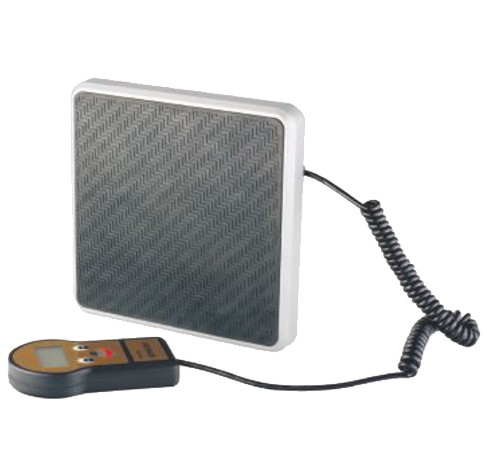
1. Mass determination of refrigerant cylinders.
Before any refrigerant enters a system, the scale must accurately determine the starting weight of a cylinder. A typical refrigeration scale uses a strain gauge load cell or an electromagnetic force restoration sensor. When a cylinder is placed on the platform, the load cell deforms slightly under weight, changing its electrical resistance. The scale’s microprocessor converts this resistance change into a digital mass reading. For a common 30 lb (13.6 kg) refrigerant cylinder, a refrigeration scale can detect differences as small as 0.2 oz (5 g). This precision is required because overcharging a system by even 100 grams of R-410A can raise high-side pressure by approximately 0.2–0.3 MPa, potentially exceeding the compressor’s design limit.
2. Tracking net weight change during transfer.
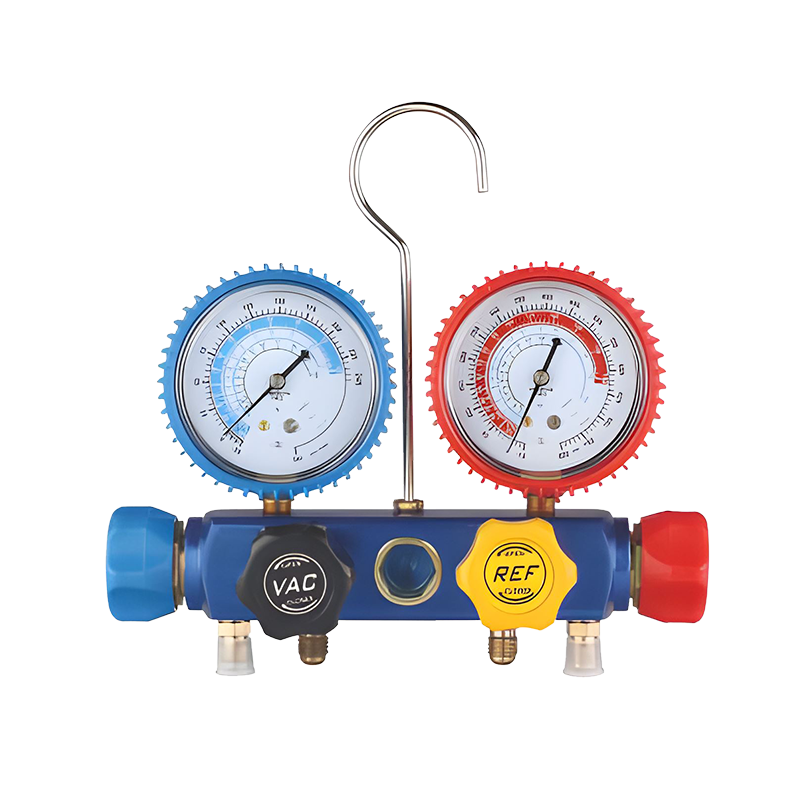
During recovery or charging, the scale continuously monitors weight loss or gain from the cylinder. The user places the cylinder on the scale, connects it to the manifold gauge set, and opens the valves. The scale’s display shows either the remaining cylinder weight or the net weight transferred. Most models include a zero/tare function to subtract the cylinder’s tare weight (stamped on the cylinder collar). For example, an empty 400 g disposable R-134a can has a tare weight of about 250 g; the scale subtracts this automatically, showing only refrigerant content. This real-time mass tracking eliminates the need for graduated cylinders or volumetric calculations, which are unreliable for refrigerants that change density with temperature.
3. Compensation for environmental factors.
Some refrigeration scales include basic temperature compensation. A load cell’s output can drift by 0.02% per °C change. For a 100 kg capacity scale, this equates to 20 g per °C. Without compensation, a scale moved from a 20 °C workshop to a 35 °C rooftop could show an error of 300 g. Mid-range scales use a thermistor to measure internal temperature and adjust the reading algorithmically. However, most service-grade scales do not correct for buoyancy effects (air displacement), which cause an error of about 0.1% of the refrigerant mass—negligible for typical HVAC work.
The second main function involves using the measured mass to charge a system correctly and to assist in performance diagnostics.
1. Controlled refrigerant charging by weight.
Manufacturers specify refrigerant charge quantities in kilograms or ounces for each system model. For a residential split air conditioner with a 5-meter line set, the correct charge might be 1.2 kg of R-32. Using a refrigeration scale, the technician places the source cylinder on the scale, connects the charging hose, and opens the cylinder valve while watching the scale’s decreasing weight reading. When the display shows exactly 1.200 kg removed from the cylinder, the valve is closed. This method is more accurate than charging by pressure (which varies with ambient temperature) or by superheat (which requires system operation). Weight-based charging achieves an accuracy of ±5 grams, while pressure-based methods can have errors of ±50 grams or more.
2. Verification of system charge after repairs.
After recovering refrigerant from a system for component replacement, the technician weighs the recovered amount. A refrigeration scale with memory function can store this value. The technician then repairs the leak or replaces the part, evacuates the system, and recharges with the same weight of virgin or recovered refrigerant. This “weigh-back” method ensures that the system operates with its factory-specified charge. If the recovered weight is less than the nameplate charge by more than 10%, a leak is confirmed. For a commercial refrigeration rack holding 50 kg of R-404A, a 2 kg loss indicates a significant leak that must be located before recharging.
The following table summarizes three major application areas, followed by detailed descriptions.
|
Application Area |
Typical User |
Refrigerant Types |
Capacity Range |
Typical Resolution |
|
Residential HVAC service |
HVAC technicians |
R-410A, R-32, R-22 |
50–100 kg |
5–10 g |
|
Commercial refrigeration |
Supermarket technicians |
R-404A, R-448A, R-449A, CO₂ (R-744) |
100–150 kg |
10–20 g |
|
Automotive AC repair |
Auto mechanics |
R-134a, R-1234yf |
30–50 kg |
1–5 g |
Related Products

Chengbei Industrial Zone, Xinhe Town, Wenling City, Zhejiang Province, China
Copyright © Wenling Xinsheng Mechanical and Electrical Co., Ltd. All Rights Reserved.



 English
 русский
 Español