Apr 03, 2026
The operating principle of an oil-free rotary vane pump differs significantly from traditional lubricated designs. Understanding this mechanism helps users appreciate both the capabilities and limitations of these machines.
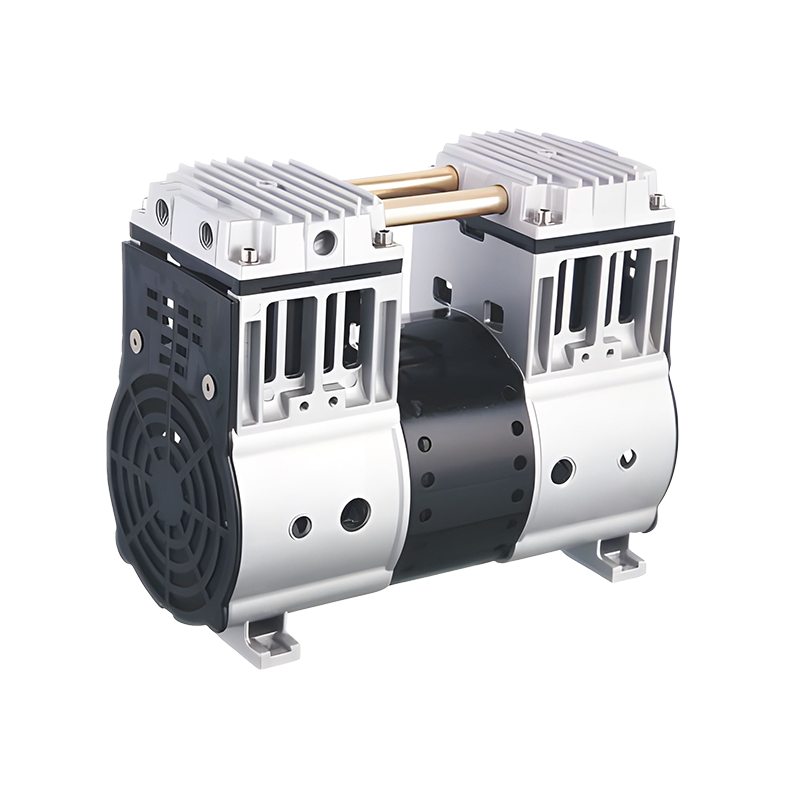
Vane Material and Design: The critical difference lies in the vanes themselves. In oil-free pumps, vanes are manufactured from self-lubricating materials, commonly graphite or carbon-graphite composites. These materials have inherent lubricating properties, allowing them to slide against the cylinder wall without scoring or galling. As the vanes wear, microscopic particles of graphite actually act as a dry lubricant between the vane and the housing.
Clearance Management: Without oil to fill gaps, oil-free pumps must maintain very precise internal clearances. The rotor, vanes, and cylinder are manufactured to tight tolerances to minimize internal leakage (backflow) of air from the discharge side back to the intake side. Some designs incorporate tip seals or other features to improve sealing efficiency without liquid lubricants.
Heat Generation and Dissipation: Because oil does not carry away heat, oil-free pumps typically run hotter than lubricated models. Manufacturers address this through design features such as:
Air cooling: Fins on the pump housing and a cooling fan mounted on the shaft dissipate heat to the surrounding air.
Larger surface areas: Housings are designed with increased surface area to radiate heat.
Thermal management materials: Aluminum housings are common because they conduct heat away from the compression chamber efficiently.
Multi-Stage Configuration: To achieve deeper vacuum levels without oil sealing, many oil-free pumps use two or more stages in series. The first stage compresses air to an intermediate pressure, and subsequent stages further compress it to atmospheric pressure. This staged approach compensates for the higher internal leakage inherent in dry-running designs.
What Maintenance Do Oil-Free Pumps Require?
One of the primary selling points of oil-free pumps is reduced maintenance compared to lubricated models. However, they are not maintenance-free. Understanding what maintenance is actually required helps in budgeting and planning.
Vane Inspection and Replacement
The carbon-graphite vanes are wear items with a finite service life. Over time, they gradually shorten as they slide against the cylinder wall. Many manufacturers specify an expected vane life, typically ranging from 10,000 to 20,000 operating hours, depending on operating conditions. When vanes wear beyond specified limits, vacuum performance declines. Inspection involves removing the pump end cover and measuring vane length or observing the contact pattern. Vane replacement is the common major maintenance procedure and requires disassembling the pump cartridge.
Bearing and Seal Maintenance
Oil-free pumps use sealed ball bearings that are grease-packed for life. In many designs, these bearings do not require routine lubrication and are replaced only when they show signs of wear or noise. Shaft seals, where the rotor shaft exits the pump housing, can eventually wear and allow air leakage. These seals are typically standard components that can be replaced during overhaul.
Filter Maintenance
The condition of inlet filters significantly affects pump performance and vane life. The inlet filter prevents airborne particulates from entering the pump, where they would act as abrasives on the vanes and cylinder. Filters should be inspected regularly and cleaned or replaced according to the manufacturer's schedule, which may range from monthly to annually depending on operating environment cleanliness.
Internal Cleaning
Depending on the application, process vapors may leave deposits inside the pump. For example, pumps used in medical applications may accumulate residue from sterilization processes. Some pump designs include access ports for introducing cleaning solutions or flushing agents to remove such deposits without complete disassembly.
What Are the Typical Applications and Limitations?
Oil-free rotary vane pumps occupy a specific niche in the vacuum equipment landscape. Their characteristics make them suitable for some applications and less suitable for others.
Common Applications
These pumps are widely used where oil contamination cannot be permitted:
Medical and Dental: Suction systems in hospitals, clinics, and dental offices rely on oil-free pumps to prevent any possibility of oil mist entering the airflow.
Laboratories: Analytical instruments, vacuum ovens, and rotary evaporators often use oil-free pumps to avoid sample contamination.
Food Processing: Packaging equipment and food handling systems require oil-free operation to meet sanitation standards.
Printing and Graphics: Sheet-fed presses and handling equipment benefit from clean, oil-free air.
Light Industrial: Pick-and-place systems, vacuum lifting, and packaging machinery often use oil-free pumps.
Performance Limitations
Oil-free pumps have inherent limitations compared to oil-lubricated designs:
Ultimate Vacuum: Single-stage oil-free pumps typically achieve ultimate pressures around 100 to 150 mbar absolute. Two-stage designs can reach 10 to 50 mbar absolute, but this is still considerably higher than the 0.5 to 1 mbar achievable with lubricated rotary vane pumps.
Flow Rate at Low Pressure: As vacuum level increases, flow capacity drops more rapidly in oil-free pumps due to internal leakage.
Continuous Duty Cycle: While suitable for continuous operation at moderate vacuum levels, sustained operation near ultimate vacuum can cause overheating and accelerated vane wear.
Vapor Handling: Oil-free pumps have limited ability to handle condensable vapors. Without oil to absorb and carry away moisture, condensate can cause vane sticking or corrosion. Some applications require gas ballast or heated pump housings to handle water vapor.
How Do I Select the Right Size and Configuration?
Selecting an oil-free rotary vane pump requires matching pump characteristics to application demands.
Determining Required Flow and Vacuum Level
The selection process begins with two fundamental questions: What flow rate is needed at what vacuum level? Applications vary significantly. A vacuum pickup tool may require high flow at relatively low vacuum, while a laboratory vacuum oven may require deeper vacuum with modest flow. Pump performance curves, available from manufacturers, show flow rate across the operating vacuum range. Selecting a pump that provides adequate flow at the required vacuum level with some margin is essential.
Considering Operating Conditions
The environment where the pump will operate influences material selection:
Ambient temperature: Pumps operating in hot environments may require additional cooling or derating.
Inlet conditions: If the pumped gas contains moisture, particulates, or aggressive chemicals, additional inlet protection (filters, traps, condensers) may be necessary.
Duty cycle: Intermittent versus continuous operation affects sizing. Continuous operation near ratings requires more conservative selection.
Evaluating Configuration Options
Manufacturers offer various configurations to suit installation requirements:
Open versus enclosed: Basic pumps are open-frame for mounting in existing equipment. Enclosed versions with sound-damping enclosures are available for noise-sensitive environments.
Motor options: AC motors in various voltages and frequencies, DC motors for mobile applications, and explosion-proof motors for hazardous locations.
Mounting arrangements: Base-mounted, tank-mounted, or custom configurations.
Related Products

Chengbei Industrial Zone, Xinhe Town, Wenling City, Zhejiang Province, China
Copyright © Wenling Xinsheng Mechanical and Electrical Co., Ltd. All Rights Reserved.



 English
 русский
 Español