Oct 30, 2026
An Oil Free Rotary Vane Vacuum Pump lives or dies by its components. No oil in the pumping chamber means everything has to work dry. Vane material? That's a big deal. Those vanes slide against internal surfaces constantly, creating friction and stress the whole time the pump runs. Material choice affects wear, heat, vacuum stability, noise, maintenance frequency. For buyers and designers, understanding this helps pick a pump that actually fits the job and lasts.
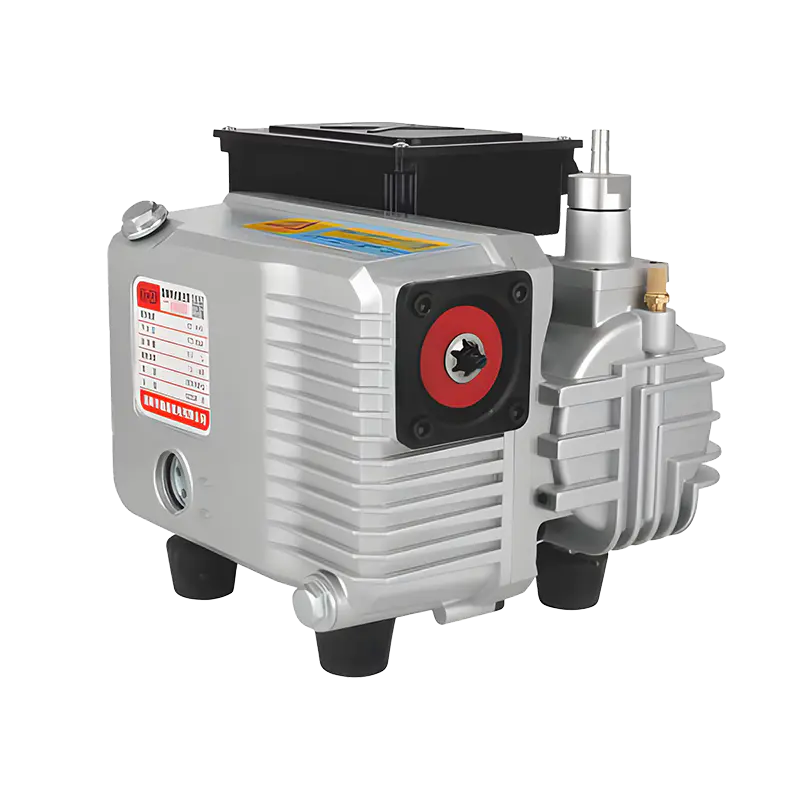
A rotary vane pump has an eccentric rotor with sliding vanes. As the rotor spins, vanes move outward and split the chamber into expanding and contracting spaces. Gas gets drawn in, compressed, pushed out. In a dry-running design, the vane material has to slide well without liquid lubrication. It also needs to hold its shape and mechanical properties under repeated movement and heat. Bad material wears fast, deforms under heat, or sheds particles that mess with sensitive processes. Changes in vane dimensions increase internal leakage and kill pumping performance. But material isn't the whole story. Rotor geometry, housing finish, clearances, operating speed, cooling—they all matter too.
Manufacturers pick vane materials based on pump design, operating environment, required service life. Carbon-based materials and engineered composites are common. Properties vary with composition and manufacturing.
| Vane material | Key characteristics | Potential limitations | Important application factors |
|---|---|---|---|
| Carbon graphite | Suitable dry-running friction characteristics and established use in vacuum equipment | Can be brittle and produce wear particles | Mechanical strength, surface finish, and particle sensitivity |
| Resin-bonded carbon composite | Can combine carbon's sliding properties with tailored structural characteristics | Heat resistance and chemical compatibility depend on the binder | Operating temperature, gas composition, and formulation |
| Engineered polymer composite | Can provide low friction and customized wear characteristics | Thermal stability and stiffness vary by polymer and reinforcement | Rotor speed, temperature, and dimensional stability |
| Specialized composite materials | Can be engineered for specific mechanical or environmental requirements | Performance and availability depend on the particular formulation | Manufacturer validation and application-specific testing |
These aren't interchangeable. Two carbon composites can differ a lot in hardness, density, strength, wear behavior. Look at the actual material spec and manufacturer data, not just the broad category.
Friction builds as vanes slide against the housing and move through rotor slots. Too much friction means more heat and faster wear on vanes and nearby components. A material with good sliding properties keeps operation stable and cuts mechanical losses. But grabbing the hardest material available doesn't automatically work better. Wrong material pairing can wear out the housing or other contact surfaces. Vane wear also messes with dimensional accuracy. As the profile changes, the pump loses some ability to maintain chamber separation. Depending on design and wear level, you get lower pumping speed, reduced vacuum, more noise. So manufacturers need to evaluate the complete contact system—vane composition, housing material, surface finish, operating clearances. The goal is a sensible balance between friction, sealing, durability.
Friction, gas compression, mechanical losses—they generate heat. If a vane material can't take the temperature, it loses stiffness, deforms, gets brittle, or deteriorates faster. These risks grow during continuous operation, frequent start-stop cycles, or hot environments. A vane that does fine in a short test may behave differently once the pump reaches thermal equilibrium. Check the manufacturer's specified operating temperature and duty cycle. Also consider ambient temperature, ventilation, installation clearance, cooling requirements of the complete assembly. Thermal resistance alone won't prevent overheating. Undersized motor, excessive mechanical load, restricted airflow, operation outside rated pressure range—any of these can cause problems. Reliable performance comes from matching vane material, pump design, operating conditions.
Vane dimensions and contact behavior influence the pump's ability to maintain pressure differences between chambers. Excessive wear or deformation increases internal leakage and affects ultimate pressure and pumping speed. Material wear can also generate particles that travel through the gas path. For labs, medical equipment, packaging systems, other cleanliness-sensitive applications, this deserves attention. An oil-free rotary vane vacuum pump eliminates oil in the pumping chamber, but oil-free doesn't automatically mean particle-free exhaust. The amount and type of wear particles depend on material, pump design, operating conditions, maintenance history. Where contamination control matters, ask about particle generation, exhaust filtration, pump suitability for the intended process. Gas composition matters too—moisture, solvents, reactive substances can affect certain materials or bonding agents.
When comparing pump models, purchasing teams and engineers should consider:
Vane material directly influences friction, wear, thermal stability, sealing behavior, contamination characteristics in dry-running rotary vane vacuum pumps. Carbon-based materials and engineered composites each offer advantages, depending on formulation and operating conditions. The right choice comes from evaluating the complete pump system and verifying performance under representative working conditions. By reviewing material specs, maintenance requirements, and documented test results before buying, equipment designers can make better-informed decisions and support more consistent vacuum performance.
Related Products

Chengbei Industrial Zone, Xinhe Town, Wenling City, Zhejiang Province, China
Copyright © Wenling Xinsheng Mechanical and Electrical Co., Ltd. All Rights Reserved.



 English
 русский
 Español