Jun 19, 2026
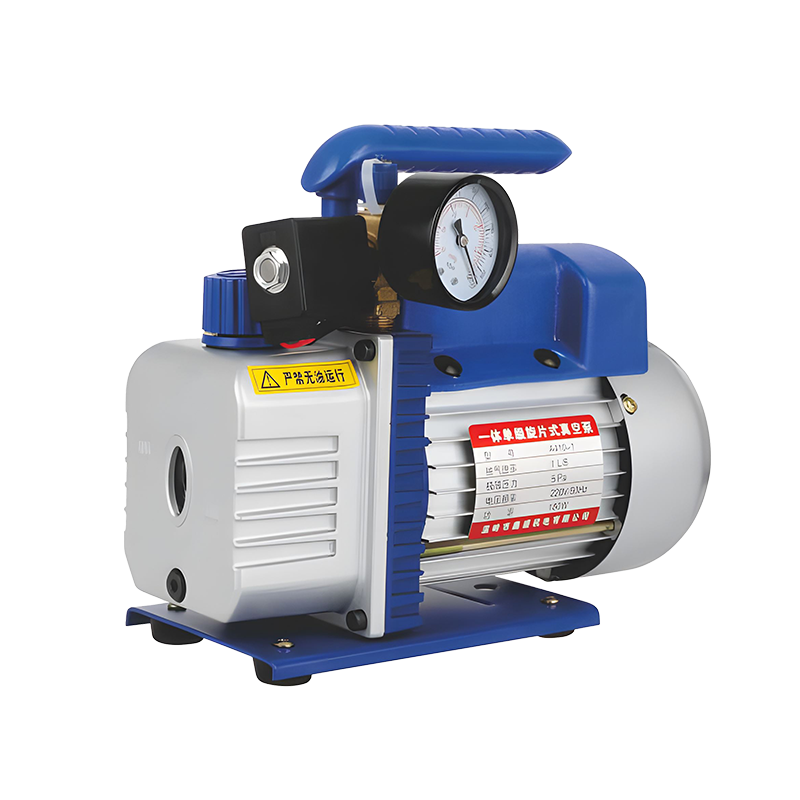
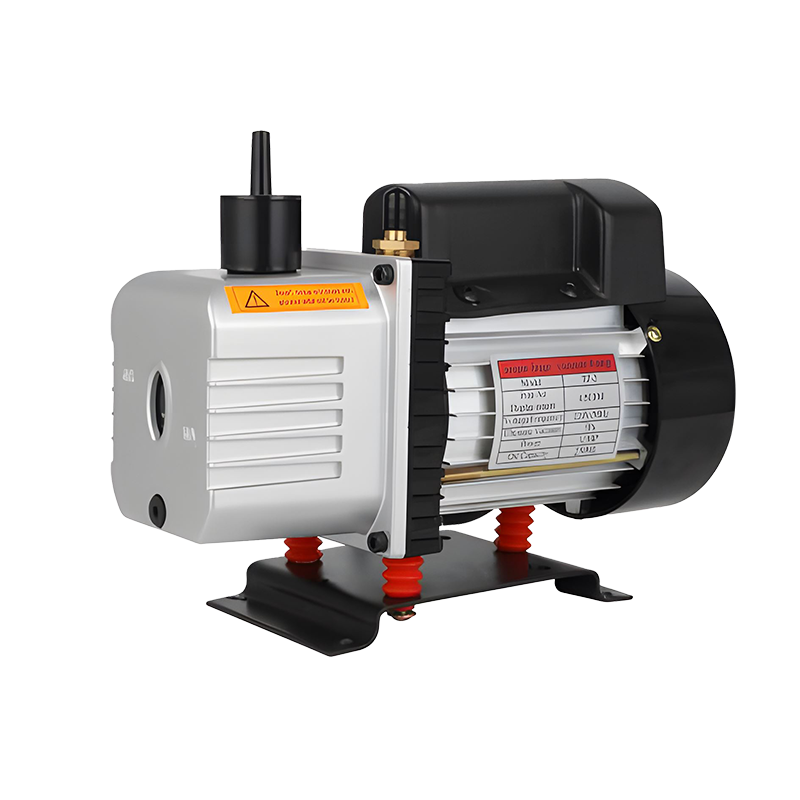
In industrial food production, equipment failures rarely trace to obvious causes. A packaging chamber that evacuates inconsistently, a drying line that keeps producing high-moisture output despite correct temperature settings, a preservation system whose hold times keep drifting — these problems share a common upstream source more often than engineers initially expect: the vacuum system. Not the recipe, not the raw material. The pump. For procurement teams and engineers specifying or upgrading food processing lines, the decision around a Rotary Vane Vacuum Pump Supplier carries more downstream consequence than many equipment choices, because the vacuum system touches food safety, output consistency, and line uptime in the same operational moment.
Removing air from a processing or packaging environment eliminates the three primary agents of food degradation: oxygen, moisture, and microorganisms. None of them thrive without air. Vacuum systems do not slow the process of spoilage — they remove the conditions that make spoilage possible. In commercial food production, that distinction is the difference between a shelf life that meets regulatory requirements and one that does not.
Below atmospheric pressure, microbial multiplication slows dramatically. Mold and enzymatic activity require moisture; vacuum pulls it out. Seal integrity, which determines whether the product remains safe after packaging, depends on the chamber reaching the required vacuum depth consistently, cycle after cycle. These are not design preferences. They are the conditions that food safety certification is built on.
One way procurement teams underestimate vacuum system complexity is by associating it only with the packaging step. In reality, vacuum appears across the production chain in different forms and with different performance demands at each point:
Each of these applications places different demands on the pump — depth, displacement, duty cycle, compatibility with process vapors. A pump that excels in packaging may not be the right specification for a drying application at the same facility.
Packaging is where vacuum pump performance is clearest and easiest to measure. A commercial packaging line runs hundreds or thousands of cycles per shift. Each cycle — evacuate, seal, vent — takes a few seconds. The pump has to hit the same vacuum depth on cycle three hundred as it did on cycle three, and it has to do that across a full shift in a warm, humid production environment.
Rotary vane vacuum pumps have settled into the standard configuration for many packaging line installations precisely because the oil-sealed mechanism holds vacuum depth stable across extended operation. The oil film across the vane surfaces prevents the internal leakage that causes cycle-to-cycle variation, which is what produces seal inconsistencies. When a packaging line starts throwing irregular seals, the investigation often ends at the pump oil condition or vane wear — not at the sealer itself.
Preservation applications run differently from packaging. The pump is not cycling rapidly — it is maintaining a reduced-pressure environment continuously, often across hours or overnight holds. The performance requirement shifts from draw-down speed to steady-state stability with minimal power consumption and low maintenance intervention.
In cold storage contexts, vacuum support systems extend the holding periods of stored ingredients or semi-processed goods without requiring additional refrigeration investment. The pump supporting this application may run quietly for days at a time, which is why thermal tolerance and oil change interval become the key specification criteria rather than peak displacement.
Vacuum drying protects food products from the damage that high-temperature atmospheric drying causes. Under reduced pressure, moisture evaporates at lower temperatures — which means the volatile compounds responsible for flavor, aroma, and color survive the drying process in better condition. Freeze drying, vacuum belt drying, and reduced-pressure spray drying all depend on pump systems that can handle the vapor load generated as moisture leaves the product.
Single Stage Vacuum Pumps work well for smaller drying chambers where the vapor volume is manageable and the vacuum depth requirement does not push past the single-stage operating range. Larger industrial systems, or those requiring very deep vacuum for freeze drying, need higher-displacement or multi-stage configurations. Getting this wrong — undersizing the pump for the chamber volume — produces the moisture-variable output that looks like a recipe problem but is actually a system capacity problem.
Vacuum marination works on a simple physical principle: alternating vacuum draw-down and pressure release causes the cellular structure of meat, poultry, or seafood to open and close, drawing liquid deeper into the product than surface diffusion would achieve. The commercial benefit is speed — a process that takes hours or overnight at ambient pressure can be compressed significantly with vacuum cycling.
The pump in this application runs in short, repeated bursts across a production day. Cycle count accumulates quickly, which means mechanical durability at the vane and seal surfaces matters more than it does in lower-cycle applications. Buyers specifying pumps for marination equipment should treat expected annual cycle count as a primary selection parameter rather than a secondary one.
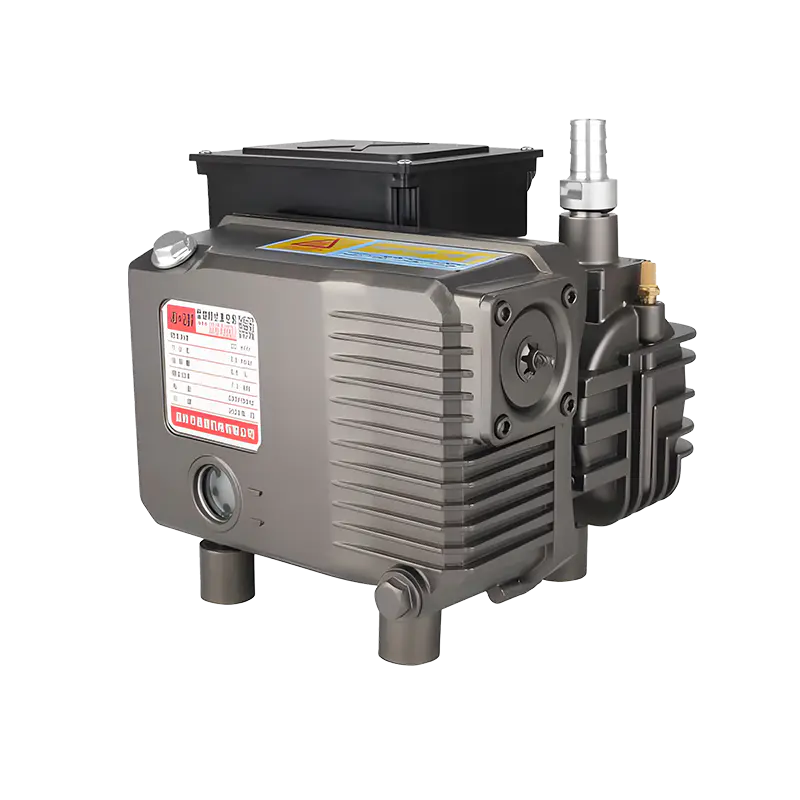
A slotted rotor sits eccentrically inside a cylindrical housing. As the rotor turns, vanes extend under centrifugal force to maintain contact with the housing wall, creating chambers that expand at the inlet and compress at the exhaust. Gas enters the expanding chambers, gets compressed, and exits at the discharge port. In an oil-sealed design, a continuous oil film across the vane tips and housing surface seals the compression chambers and lubricates the contact faces simultaneously.
The practical outcome is a pump that produces smooth, continuous flow to relatively deep vacuum levels. The pulsed output of reciprocating pumps creates pressure variation inside a packaging chamber that affects seal uniformity at the edges. Rotary vane designs do not have this characteristic, which is one reason they suit high-cycle packaging applications.
The oil is both the mechanism and the constraint. For applications where the pump is physically remote from food contact surfaces and equipped with appropriate inlet filtration, oil-sealed designs are typically acceptable under food processing facility standards. But where the pump connects directly to a processing environment where oil vapor reaching the product would constitute a contamination risk, dry pump configurations become the correct specification regardless of performance preference.
This distinction — oil-sealed or oil-free — is not a cost preference. It is a hygiene and regulatory decision that the application context determines. A reliable Rotary Vane Vacuum Pump Supplier will ask about the installation context before recommending a configuration, not after the unit has been installed and the facility's hygiene audit raises the question.
Additional characteristics that suit rotary vane designs to food production environments:
Not every food processing application needs the same vacuum depth or the same pump architecture. Matching configuration to requirement avoids both underperformance and unnecessary cost.
| Pump Type | Vacuum Depth | Throughput Range | Typical Food Application | Primary Consideration |
|---|---|---|---|---|
| Single Stage Vacuum Pump | Moderate | Low to medium | Small packaging lines, batch drying | Lower purchase cost, straightforward maintenance |
| Two-Stage Rotary Vane | Deeper | Medium to high | Industrial packaging, preservation systems | Higher performance with increased unit cost |
| Dry Claw Pump | Moderate | Medium | High-hygiene environments, direct food contact zones | No oil contamination pathway |
| Liquid Ring Pump | Moderate | High | Wet processing, high-vapor applications | Suited to condensable vapor handling |
| Roots Booster Pump | Very deep | High | Freeze drying, large-volume chambers | Requires a backing pump in combination |
A Single Stage Vacuum Pump handles one compression stage — gas enters, compresses, exits. For applications where the required vacuum depth falls within the single-stage operating range and the throughput is modest, it is a cost-effective and mechanically uncomplicated choice. Small packaging operations, batch equipment, and pilot lines are natural fits.
Where the application demands deeper vacuum than a single stage reaches, or where displacement needs to handle large chamber volumes quickly, the specification moves to two-stage or combination configurations. A Vacuum Pump Factory that carries a range across these types can do this matching exercise with the buyer based on the actual application parameters rather than defaulting to the available inventory.
Selection gets complicated when buyers try to evaluate all parameters simultaneously. Working through them in order is faster and produces a cleaner specification.
Define the vacuum level at the outset. Packaging lines, preservation systems, and freeze drying operate at different absolute pressures. Identifying the required vacuum depth eliminates a large portion of the available pump options immediately, which simplifies the rest of the evaluation.
Determine displacement volume next. The pump must move enough gas per unit time to evacuate the chamber at the required speed. Undersizing the pump here is a throughput problem that cannot be corrected without pump replacement. Oversizing it wastes capital and energy without performance benefit.
Assess the hygiene context. This is the decision point between oil-sealed and oil-free. Where the pump sits relative to food contact surfaces, what regulatory environment the facility operates under, and whether inlet filtration is sufficient to prevent vapor migration — these are the questions that resolve the oil question. Answering them with the facility's food safety team before specifying the pump avoids a compliance issue after installation.
Evaluate the duty cycle honestly. A two-shift packaging line and a once-daily batch operation both qualify as "food processing," but they place fundamentally different demands on the pump over a year of operation. Thermal management, oil change frequency, and vane wear rates all scale with operating hours. The pump specification should reflect the actual schedule, not an idealized one.
Check vapor and condensate behavior. Applications that generate significant water vapor during evacuation can accumulate condensate in pump oil if the pump lacks gas ballast capability. The oil becomes contaminated, lubrication degrades, and pump performance drops in a way that is slow to diagnose. Identifying whether the application produces condensable vapors during the selection stage prevents this from becoming an operational problem.
Identify where standard designs do not fit. Food processing facilities are built around specific line configurations, and pumps are often installed in constrained spaces with particular connection requirements. A Custom Vacuum Pump — modified port placement, adapted mounting flanges, specific motor specification for integration with existing control architecture — is not an unusual request for suppliers with engineering capability. It is a practical way to avoid performance compromise from forcing a standard unit into a non-standard installation.
A supplier who machines their own components controls the dimensional tolerances that determine pump performance: vane clearances, housing concentricity, surface roughness on the contact faces. These parameters govern how the oil film behaves, which governs vacuum stability. A Vacuum Pump Factory that assembles from externally sourced subassemblies can still produce acceptable products, but control over the parameters that matter sits outside their process — which creates a quality dependency they cannot fully manage.
For food processing applications specifically, finished pump testing before shipment is not optional. Vacuum depth verification, leak rate testing, and a production run-in that confirms stable output at operating temperature are the baseline checks. Suppliers who cannot provide this documentation, or who treat it as an unusual request, are signaling something about their process confidence.
A supplier who has worked with food processing facilities knows what hygiene compliance looks like in practice, not just on a specification sheet. They understand the difference between a pump installed in a utility room and one installed in a production area, what documentation a food facility audit requires, and what questions about contamination risk are likely to come up during the qualification process. This knowledge is not theoretical — it comes from having navigated the same conversations with other food processing buyers.
A general industrial pump supplier may offer a technically equivalent product but will not have this application context. The difference shows up not during the sale but during the installation, the audit, and the first maintenance cycle.
Food equipment manufacturers and system integrators source vacuum pumps as components, not as standalone products. The pump has to fit a defined envelope, connect to a specific control architecture, and deliver a performance specification within the constraints of the larger system. Suppliers with genuine OEM capability — engineering engagement, modified configurations, co-development support — are a different class of partner from catalog distributors. The distinction matters most when the application sits outside the standard specification range, which food processing environments often do.
Vanes wear. Oil needs changing. Inlet filters accumulate debris. None of this is avoidable in a pump running production hours. A supplier who stocks replacement vanes and seals, provides clear maintenance interval guidance, and can offer technical support when a problem occurs in the field is providing the service continuity that food production operations depend on. A supplier who sells the pump and considers the relationship complete is not.
China vacuum pump manufacturing has developed well beyond the commodity tier that some buyers associate with it. Factories supplying international food equipment manufacturers operate to the documentation standards, quality management processes, and customization depth that these buyers require.
Supplier qualification is where a large share of procurement problems are prevented. Factory visits or third-party inspection, review of quality management documentation, and request for application-specific performance test data are appropriate steps for vacuum equipment going into regulated food processing environments. A supplier who welcomes this scrutiny is a different kind of partner from one who resists it.
Rotary vane vacuum pumps cover the widest range of food processing applications because of their stable vacuum output and tolerance for continuous operation. Dry claw pumps are specified where oil contamination risk cannot be accepted. Liquid ring pumps handle wet processing environments where condensable vapors would damage an oil-sealed design.
Consistent vacuum depth across repeated cycles is the key packaging requirement. The oil-sealed mechanism prevents the internal leakage that causes depth variation between cycles, which translates directly to uniform seal quality. Smooth continuous flow also avoids the pressure pulsing that can affect chamber uniformity during draw-down.
Single stage configurations are well-matched to smaller packaging operations, batch drying equipment, and pilot or development-scale production where chamber volumes are modest and the required vacuum depth is within the single-stage operating range. They offer a straightforward maintenance profile and lower initial cost for applications that do not require the deeper vacuum or higher displacement of multi-stage systems.
It determines whether an oil-sealed or oil-free design is appropriate. Where the pump is physically separated from food contact surfaces and inlet filtration is in place, oil-sealed designs typically satisfy facility hygiene requirements. Where direct connection to a food contact environment exists, or where the facility's food safety audit would flag oil vapor as a contamination pathway, dry configurations are the correct specification.
Manufacturing process documentation and finished pump test data are the starting point. Vacuum depth and leak rate at delivery, vane and seal parts availability, the supplier's familiarity with food processing facility requirements, and their ability to support custom configurations if needed — these are the qualification criteria that predict how the relationship will perform across the supply lifecycle, not just the initial transaction.
Yes, at suppliers with in-house engineering capability. Modified inlet and outlet port placement, adapted mounting flanges, motor specifications for compatibility with existing control systems, and in some cases internal geometry changes for specific vapor handling requirements are all within the scope of what experienced vacuum pump factories develop for OEM and system integrator customers.
Vacuum pump specification in food processing is a systems decision, not a catalog selection. The application context — vacuum depth required, chamber volume, duty cycle, hygiene zone classification, vapor characteristics — defines the viable configurations before any supplier conversation begins. Getting these parameters clear reduces the risk of purchasing a pump that performs adequately in testing and underperforms in sustained production. The supplier decision follows a similar logic: a Vacuum Pump Factory with direct manufacturing capability, genuine food industry application experience, and custom configuration support is a different kind of partner than a standard distributor, and that difference accumulates across the service life of the equipment. Downtime in a food processing line is not an abstract cost — it is product that did not get made, packaging that failed audit, a cold chain that was interrupted. If you are specifying vacuum equipment for a food processing application, whether for a new line, a capacity upgrade, or a replacement installation where existing equipment is not holding its performance, Wenling Xinsheng Mechanical and Electrical Co.,Ltd. provides rotary vane vacuum pump configurations with the technical documentation, customization depth, and food industry application experience that regulated production environments require. Sharing your application parameters — vacuum level, chamber volume, duty cycle, hygiene classification — is the practical starting point.
Related Products

Chengbei Industrial Zone, Xinhe Town, Wenling City, Zhejiang Province, China
Copyright © Wenling Xinsheng Mechanical and Electrical Co., Ltd. All Rights Reserved.



 English
 русский
 Español